50 Human Rights Icons: A Complete Toolkit for Visual Storytelling
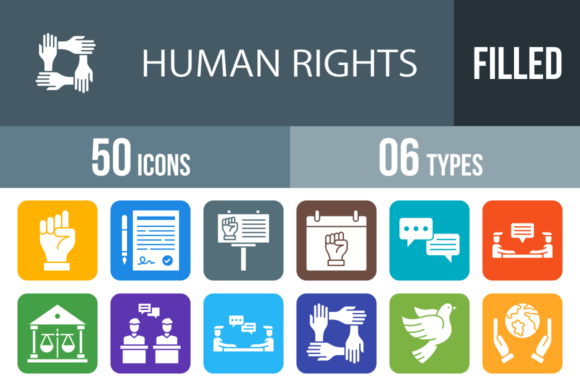
In the realm of digital communication, abstract concepts often require concrete visual representations to resonate with an audience. When addressing critical topics like social justice, equality, and legal frameworks, generic stock imagery often falls short, failing to capture the gravity or specificity of the message. This is where the 50 Human Rights Filled Round Corner Icon set steps in. It is not merely a collection of symbols; it is a comprehensive visual language designed for modern advocacy, corporate social responsibility (CSR) reporting, and educational content. Crafted with a unigrid system, this set ensures that every icon, from "Activism" to "Vote," maintains a consistent geometric harmony, making it an indispensable asset for designers, marketers, and activists alike.
Visual Characteristics and Design Personality
The defining feature of the 50 Human Rights Filled Round Corner Icon set is its approachability. By utilizing a filled style with softened, round corners, the icons project a friendly yet authoritative personality. Sharp edges can sometimes feel aggressive or dated in modern interface design; however, the rounded aesthetic aligns perfectly with current UI trends seen in iOS and Material Design guidelines. This style ensures that the icons feel native to the mobile environment while retaining enough weight to stand out in print media.
Technically, the design relies on a unigrid system. This means that the visual weight, spacing, and structural geometry are standardized across the entire set. Whether you are using the "Courthouse" icon or the "Diversity" symbol, they will align perfectly on a pixel grid. This is crucial for web design and app development, where misaligned assets can ruin the professional polish of a user interface. The personality of these icons is versatile: they are serious enough for legal contexts—covering "Justice," "Law," and "Jury"—yet accessible enough for community-focused projects involving "Love," "Support," and "Solidarity."
Practical Applications Across Industries
The utility of the 50 Human Rights Filled Round Corner Icon extends far beyond simple decoration. For graphic designers and brand strategists, these icons serve as vital design assets for building a cohesive brand identity around social values.
- Digital and Web Design: In web design, icons are essential for breaking up text and guiding the user’s eye. Use the "Chat," "Communication," and "Opinion" icons to highlight community forums or feedback sections. The "Search" and "Calendar" icons can be integrated into navigation menus for NGOs and human rights organizations. Because the set includes 100% vector icons, they remain crisp on retina displays and high-resolution screens.
- Mobile App Development: The icons are optimized for mobile interfaces. The "Protest," "Petition," and "Vote" icons are perfect for civic engagement apps, allowing developers to create intuitive tab bars or onboarding screens without custom illustration costs. The 20 PNG Sizes included ensure you have the exact pixel dimensions needed for Android density buckets (mdpi, hdpi, xhdpi) and iOS points.
- Editorial and Publishing: For bloggers and content creators focusing on politics or sociology, these icons act as visual anchors. Instead of using generic bullet points, a small "Equality" or "Diversity" icon can instantly signal the article's subject matter. This enhances visual hierarchy and reader engagement.
- Presentation and Corporate Use: In presentation design, clarity is king. The "Meeting," "Agreement," and "Investor" icons are excellent for corporate decks discussing ESG (Environmental, Social, and Governance) criteria. They replace cluttered clip art with clean, modern typography-compatible visuals.
- Social Media Graphics: On fast-scrolling feeds like Instagram or Twitter, visual recognition must be instant. The "Megaphone," "Protest," and "Peace Flag" icons are bold enough to be used as standalone graphics or integrated into story highlights to drive awareness campaigns.
Technical Versatility and File Formats
A significant advantage of this icon pack is its technical readiness. It is not just a static image; it is a toolkit. The inclusion of AI, CDR, EPS, JPG, PNG, and SVG formats means this asset is platform-agnostic.
The SVG (Scalable Vector Graphics) format is particularly valuable for web design. SVGs are code-based, meaning they load faster than image files and can be manipulated via CSS. You can easily change the color of the "No Racism" or "No War" icons to match your website's palette without opening a graphic design program. Conversely, the EPS and AI files allow for deep editing in Adobe Illustrator, enabling designers to modify the paths of the "Slavery" or "Repression" icons to fit a specific artistic direction.
This level of editability ensures that the 50 Human Rights Filled Round Corner Icon set functions as a premium font or asset library would—providing a foundation that you can customize to create a unique derivative work. Whether you are working on packaging design for a non-profit product or creating merchandise, the vector nature ensures that the lines remain sharp, whether printed on a business card or a billboard.
Enhancing Visual Hierarchy and Audience Engagement
Effective design is about managing the viewer's attention. The 50 Human Rights Filled Round Corner Icon set helps establish a clear visual hierarchy. When used in an infographic, icons like "Statistics" (represented by the Billboards or Charts) or "Gender Equality" can segment complex data into digestible chunks.
Furthermore, these icons influence brand perception. A brand that utilizes high-quality, consistent icons appears more professional and trustworthy. For a law firm, using the "Legal," "Courthouse," and "Protection" icons reinforces their expertise. For a grassroots movement, the "Handcuffs," "Fight," and "Freedom" icons evoke emotional resonance and urgency. This consistency builds brand identity and aids in recognition. Users begin to associate specific shapes with specific meanings, reducing cognitive load and improving the overall user experience.
Practical Guidance for Implementation
When integrating the 50 Human Rights Filled Round Corner Icon into your projects, consider the following best practices to maximize their impact:
- Evaluate Context and Tone: While the round corners make the icons friendly, some subjects are inherently heavy. The "Prisoner," "Violence," and "Handcuffs" icons should be used with care. Ensure the surrounding design elements support the serious nature of these topics without trivializing them.
- Font Pairing: Icons should complement, not compete with, your typography. Because these icons have a geometric, rounded style, they pair exceptionally well with sans serif fonts like Roboto, Open Sans, or Montserrat. If you are aiming for a more traditional look, a sturdy serif font can provide a nice contrast to the modern icon lines. Avoid overly decorative script fonts or handwritten fonts for body copy when using these icons, as the clash between whimsical text and functional icons can confuse the reader.
- Color Application: The "Filled" style means these icons have solid shapes. Use color strategically. A monochromatic scheme (varying shades of one color) creates a sophisticated, corporate look. Alternatively, using semantic colors—like red for "No Gun" or green for "Earth Day"—can provide instant context, though be mindful of cultural color associations.
- Testing for Readability: Before finalizing a design, test the icons at the smallest size they will appear in. The 20 PNG Sizes provided are helpful here. Ensure that the internal details of the "Jury" or "Solidarity" icons do not blur together at 16x16 pixels. If they do, consider using a simpler icon or increasing the size.
- Licensing and Usage: Always verify the license for commercial use. While this set is designed for broad application, understanding the terms ensures you can use the assets in logo design, merchandise, or client work without legal hurdles.
Ultimately, the 50 Human Rights Filled Round Corner Icon set is more than a collection of graphics; it is a facilitator of communication. It bridges the gap between complex human rights issues and clear, accessible visual communication. By leveraging these design assets